Monarchy is the Popery of government
Common Sense“Monarchy is the Popery of government” is Thomas Paine’s compact indictment of kingship as a political form that demands an illegitimate reverence and suppresses the scriptural evidence against it. The expression gathers together his reading of Israel’s demand for a king, his criticism of hereditary power, and his proposal that a free polity place law—not a ruler—at its summit.
Meaning and Political Force
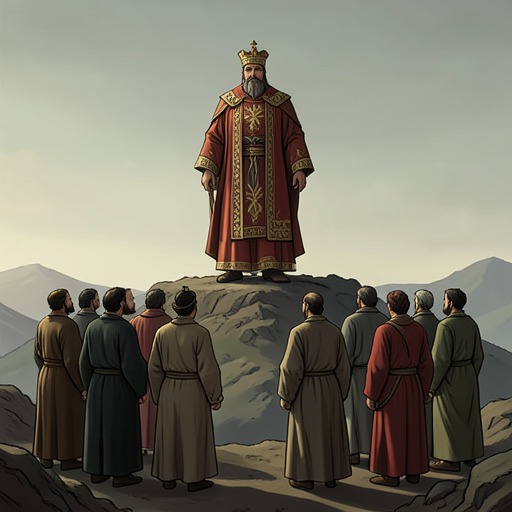
Paine’s analogy casts monarchy not merely as an inefficient arrangement but as a system of political belief. He argues that elevating one person above others cannot be justified by the equal rights of nature or by scripture. In his account, reverence for kings encroaches on divine prerogative: the title “sacred majesty” makes a mortal ruler appear more than mortal, while subjects are trained to accept political hierarchy as rightful. The analogy with Popery makes the point polemically: monarchy, like a religious authority that shields its claims from scrutiny, depends on inherited deference and the obscuring of inconvenient teachings.
The expression is the culmination of a scriptural argument rather than an isolated flourish. Paine insists that anti-monarchical passages have been glossed over in monarchies, and contends that the injunction to render unto Caesar does not endorse kingship: when that teaching was given, he says, the Jews had no king and lived under Roman rule. His claim is that scripture’s political lesson has been misrepresented to protect monarchy, just as the pomp surrounding kings lends sacred weight to a human institution.
Gideon, Samuel, and the Rejection of Kingship
Paine first invokes Gideon, who, after victory over the Midianites, was offered rule not only for himself but for his descendants. Gideon refused, declaring that neither he nor his son would rule over the people because the Lord would rule over them. Paine treats the refusal as explicit: Gideon does not merely decline a personal honor but denies the people’s right to confer a kingship that would displace their proper sovereign.
About 130 years later, the people again asked for a king. They cited the misconduct of Samuel’s two sons, but Paine stresses the motive they themselves announced: they wanted to be like other nations, and to have a king judge them and lead them into battle. The request thus appears not as a necessary correction to bad administration but as an embrace of surrounding custom. The divine reply to Samuel, as Paine presents it, identifies the demand as a rejection of God’s rule and recalls the people’s repeated departure from it.
Samuel’s warning makes the political cost of kingship concrete. A king will take sons for chariots, cavalry, military command, agricultural labor, and the making of weapons; daughters for service in his household; the best fields and olive yards for his servants; and a tenth of crops, vineyards, servants, young men, asses, and sheep. The warning moves from public service to household and property, depicting royal authority as a chain of appropriations that reaches into ordinary life. Paine links the levies on produce and land to bribery, corruption, and favoritism, and interprets the taking of people and resources as the structural price of monarchy.
The people persist despite Samuel’s reasoning. When Samuel calls for thunder and rain during the wheat harvest, the storm frightens them into acknowledging that asking for a king has added evil to their sins. For Paine, this episode is decisive evidence that scripture registers a protest against monarchy. Even the praise of David, he argues, honors him as a man after God’s own heart, not officially as a king; the goodness of particular rulers cannot sanctify the institution’s origin.
Hereditary Power and Political Submission
Paine’s criticism extends from monarchy to hereditary succession, which he describes as an additional injury to equality. If people begin as equals, no one can claim by birth a perpetual right to prefer his family over all others. A founder might merit honors from contemporaries, but that does not establish that descendants deserve them. Nature itself, in Paine’s deliberately derisive image, exposes the folly of hereditary right by sometimes giving humanity an ass for a lion.
Nor, he argues, can one generation grant away the political rights of those who follow it. A people might choose someone as their own head, but that choice cannot justly bind their children and grandchildren to that person’s descendants. Such an arrangement could place posterity under a rogue or a fool. Once established, hereditary rule is difficult to remove: some submit through fear, others through superstition, while the powerful share with the king in the plunder of the rest. The phrase’s attack on monarchy therefore extends beyond the ruler’s conduct to the habits of deference and material interest that keep the institution in place.
From Royal Authority to Law and Representation
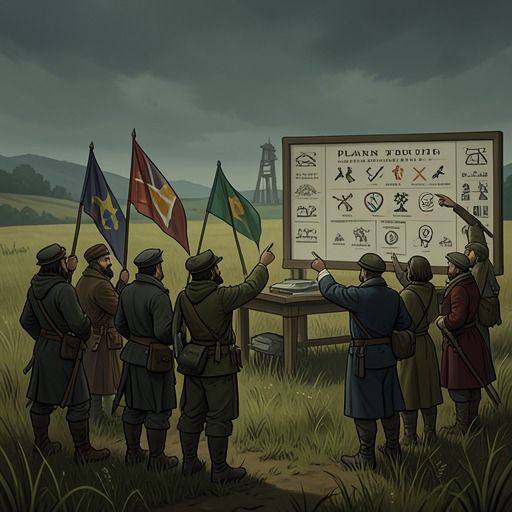
Paine’s alternative is not a vacuum of authority but government built through public representation and a written compact. He proposes annual assemblies with a president, domestic responsibilities for those assemblies, and subordination to a Continental Congress. Each colony would be divided into six, eight, or ten districts, and would send at least thirty delegates, producing a Congress of at least 390 members. The presidency would rotate among colonies selected by lot, with delegates from the chosen colony electing the president; a three-fifths threshold would be required for a majority.
He also proposes an intermediate Continental Conference joining congressional members, members of colonial assemblies or conventions, and representatives chosen by the people. Its task would be to frame a Continental Charter defining representation, election, sitting dates, and the division of jurisdiction. The charter would secure freedom and property, and especially the free exercise of religion according to conscience. This structure answers the expression’s central objection: authority is to be constituted, limited, and authorized by the governed, rather than inherited as a personal possession.
The charter’s public proclamation would dramatize the reversal. Paine imagines placing it upon the word of God and setting a crown upon the document, so that the governing principle would be unmistakable: “THE LAW IS KING.” At the ceremony’s end, the crown would be demolished and scattered among the people, whose right it represents. The image turns the royal emblem from an object of concentrated power into a sign of popular authority under law.
Paine returns to the need for such constitutional foundations when warning that a government seat left unoccupied might be seized by a fortunate ruffian, as William the Conqueror imposed law on England by the sword. He argues that government must protect people of every religious persuasion, while having no other business with religion. His defense of religious difference and his attack on political sacralization meet in the same principle: no earthly authority should claim an obedience that belongs elsewhere, and public power must be bounded by a charter and accountable law.
The Phrase as a Summary of the Argument
The expression joins scriptural interpretation to institutional design. Gideon’s refusal and Samuel’s warning supply Paine’s case against the legitimacy and costs of kingship; hereditary succession shows how that power claims to bind generations that never consented to it. His constitutional proposals then replace royal elevation with representation, defined jurisdiction, protected rights, and law as the highest earthly authority. “Monarchy is the Popery of government” names the error he seeks to dislodge: treating political authority as sacred and beyond the people’s judgment.